
So, you’re thinking about replacing your windows. One of the first questions on every homeowner’s mind is, “How much is this going to cost?” Let's cut right to the chase.
On average, you can expect the window replacement cost to fall somewhere between $600 to $1,300 per window, with installation included. For a whole-house project, most people find their total investment lands between $3,441 and $11,839, but this range can shift based on the quality of the windows and the complexity of the job.
Understanding Your Window Replacement Cost in 2026
When you first start looking up the cost of new windows, the numbers can feel like they're all over the place. One website might quote a few hundred dollars, while another suggests thousands. The truth is, they can both be right.
Think of it like buying a car. The final price tag depends entirely on whether you're after a basic, reliable sedan or a fully-loaded luxury SUV. Your final window cost is a mix of the window itself (the make and model), the labor to install it, and a few other job-specific details.
These numbers are national averages, and local market conditions play a big role. Here in the Central Valley, our team at Equity Building Materials can walk you through how these figures translate to your own Fresno-area home.
A Starting Point for Your Budget
To help you get a clearer picture, let's look at some typical project costs. This is a great way to establish a baseline budget before you get into the finer details of materials and styles.
This table provides a quick overview of estimated total costs based on the number of windows being replaced in a typical residential project.
Average Window Replacement Cost By Project Size (2026)
| Number of Windows | Typical Project Cost Range |
|---|---|
| 1 Window | $600 – $1,300+ |
| 5 Windows | $3,000 – $6,500+ |
| 10 Windows | $6,000 – $13,000+ |
| 15 Windows | $9,000 – $19,500+ |
Remember, these ranges are for standard installations of good, mid-grade windows. If your project involves custom sizes, high-performance glass, or a more complicated installation, your costs will likely be on the higher end of these estimates.
Balancing Cost and Return on Investment
It’s tempting to think of new windows purely in terms of boosting your home's resale value, but it's a bit more nuanced than that. Unlike a splashy kitchen remodel, the return on investment for windows is often felt more in your daily life than on a closing statement.
Recent data shows the real value of window replacement is in comfort and long-term savings, not just a dollar-for-dollar increase in home equity. For example, while the average homeowner spent $7,355 on window replacement in 2026, a separate analysis found that a vinyl window project costing $20,091 might only add about $13,766 in resale value. This highlights the importance of choosing windows for their performance and efficiency benefits. You can see a full breakdown in this cost analysis from Angi.com.
This gap doesn't mean new windows aren't a smart move. It just means their true worth lies in the day-to-day benefits: lower energy bills, a quieter and more comfortable home, and a fresh look for your property. That's a return you get to enjoy every single day.
Why Window Replacement Prices Are So High
If you’ve started getting quotes for new windows and felt a little sticker shock, you’re not alone. It's not your imagination—the price of a window replacement project has been climbing steadily, and it's a trend we've seen firsthand.
This isn't some arbitrary price hike. It's a direct result of real-world pressures on manufacturing and labor. Understanding what’s driving these costs helps make sense of the estimate in your hand and empowers you to make a smart investment.
A perfect storm of economic factors, especially in recent years, has pushed prices upward. Let’s break down exactly what’s going on behind the scenes.
The Rising Price of Raw Materials
A window is really just a sum of its parts: glass, frame material, hardware, and seals. When the cost of those core ingredients goes up, the price of the finished window has to follow.
Think of it like baking a cake. If the price of flour, sugar, and eggs suddenly doubles at the grocery store, the cake you bake is naturally going to cost more. The window industry is facing the same issue, just on a much larger scale.
- Glass and Sealant Shortages: High demand and disruptions in manufacturing have made it harder to get raw glass. The same goes for the special inert gasses, like argon, that are used to create energy-efficient double and triple-pane windows.
- Metal Tariffs and Volatility: Tariffs on imported materials like aluminum and steel directly increase the cost of window frames, reinforcements, and hardware—from locks and handles to the internal cranks.
- Fuel and Shipping Costs: Everything has to be shipped. Bouncing fuel prices mean it costs more to get raw materials to the factory and even more to transport finished windows to suppliers like us here in Fresno.
All these factors create a ripple effect, adding cost at every single step of the process, from the factory floor right to your front door.
The Skilled Labor Squeeze
A high-quality window is only as good as the person installing it. The problem is, the demand for experienced, professional installers has shot past the available supply.
This isn't a job anyone can do. It takes serious precision and an understanding of modern building science to get that perfect, airtight, and watertight seal that will last for decades. Because there are fewer skilled installers available, their expertise is in high demand, which drives up labor rates.
A project that might have cost $17,641 for vinyl windows back in 2020 climbed to an average of $20,091 by 2026—that’s a jump of about 14%. This increase is fueled by both material costs and the shortage of qualified installers. Labor rates for a standard installation now often run from $100 to $300 per window, with complex jobs costing much more. You can read more about these industry trends from Energy Swing Windows.
When you work with Equity Building Materials, part of your investment is securing our team of trained, in-house professionals—not random subcontractors. That commitment guarantees accountability and a higher standard of work you can count on.
Knowing these trends brings up an important point: waiting to replace your windows could mean paying even more down the road. Getting a quote today is the best way to lock in current pricing and navigate the market with a trusted local expert on your side.
How Window Materials and Styles Drive Your Cost
When you start planning a window replacement project, you’ll quickly find that the biggest factor influencing your total cost is the window itself. It’s a lot like buying a car—the final price can swing wildly depending on whether you’re looking at a basic, reliable sedan or a fully-loaded luxury SUV. The same goes for windows; your choice of material and style sets the foundation for your entire budget.
Each material comes with its own unique mix of cost, durability, and upkeep. Making the right choice here is the first step to a successful project that fits both your home and your wallet.
Window Material Cost and Feature Comparison
The frame is the backbone of your window. It dictates not just how the window looks, but also how well it insulates, how long it will last, and how much maintenance it will need. Let's look at the most common materials side-by-side to see how they stack up.
| Material Type | Average Cost Per Window | Key Features | Best For |
|---|---|---|---|
| Vinyl | $450 – $800 | Low maintenance, excellent energy efficiency, won't rot or peel, most popular. | Homeowners looking for the best all-around value and performance. |
| Fiberglass | $650 – $1,100 | Extremely strong and durable, minimal expansion/contraction, paintable finish. | Climates with extreme temperature swings and those wanting superior longevity. |
| Wood | $900 – $1,800+ | Classic, beautiful appearance, natural insulator, can be stained or painted. | Historic homes or those aiming for a premium, traditional aesthetic. |
| Aluminum | $75 – $400 | Strong, lightweight, slim frame profile for a modern look, very durable. | Budget-conscious projects, commercial buildings, or temperate climates. |
This table gives you a great starting point, but seeing the materials in person can make all the difference. You can get a feel for the different looks and builds by stopping by the Equity Building Materials showroom.
Price Points and Market Trends
As you can see, the price gap between materials is significant. As of 2026, vinyl windows are still the go-to for affordability, typically running $450–$800 per window, installed. For its superior strength, fiberglass commands a higher price of $650–$1,100 per window. At the premium end of the spectrum, you have wood replacement windows, which start around $900 and can easily climb to $1,800 or more. For the most budget-focused projects, aluminum windows can be found for as low as $75–$400 per window.
It's also important to remember that prices aren't static. Market factors like material shortages and labor costs cause prices to shift over time. Just look at how the cost of a typical vinyl window project has changed in recent years.
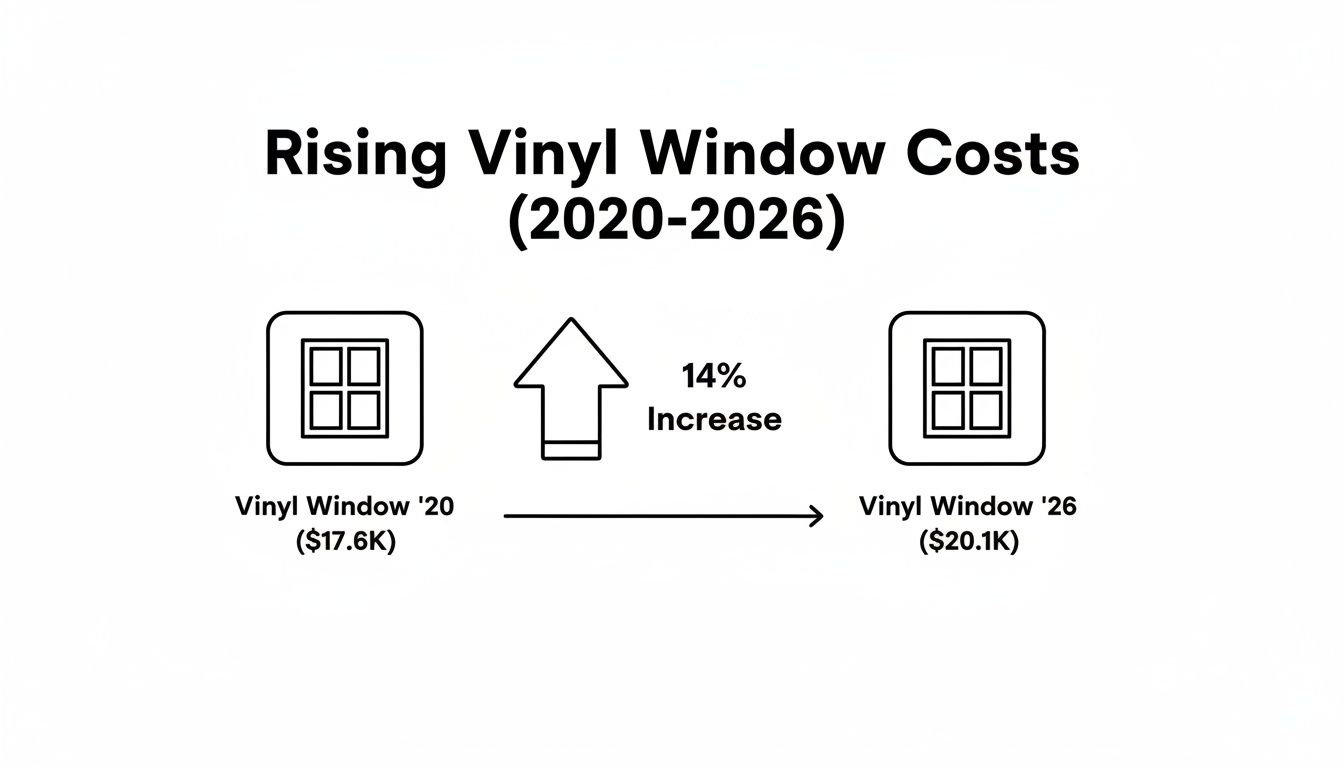
This 14% increase shows exactly why getting a current, accurate quote is so critical for budgeting properly.
How Window Style Impacts Your Final Bill
Once you've settled on a material, the next thing that will shape your bill is the window's style—how it opens and operates. A simple, stationary window will always be cheaper than one with complex moving parts.
Think of it this way: a standard single-hung window that just slides up and down is like a simple light switch. It does its job reliably. A large, elegant bay window that juts out from your house is more like installing a whole smart lighting system—it's far more complex, requires more materials, and takes a lot more skill to install correctly.
Here’s a quick rundown of common styles, generally listed from the most affordable to the most expensive:
- Picture (or Fixed) Windows: These don’t open at all. Their simplicity makes them the least expensive option and a great choice for maximizing views and light in spaces where you don’t need airflow.
- Single-Hung & Double-Hung Windows: These are the classic windows that slide vertically. Single-hung have one moving sash (the bottom one), while double-hung allow both sashes to move for more flexible ventilation.
- Sliding Windows: These operate on a horizontal track, gliding from side to side. They’re easy to use and offer a clean, modern look.
- Casement & Awning Windows: Operated by a hand crank, these windows swing outward. This design allows them to seal up incredibly tightly when closed, making them a top choice for energy efficiency.
- Bay & Bow Windows: These architectural showstoppers are the most expensive. They are actually a combination of three or more windows joined together to extend out from the house, creating a small nook inside. Their high cost comes from the multiple window units, plus the complex framing and roofing required to build them.
Ultimately, your final window replacement cost will be a balance between the material that best suits your home's needs and the style that you love. Understanding how these two key choices influence your budget is the best way to make a confident decision.
Breaking Down Your Labor and Installation Costs
You can pick out the most beautiful, energy-efficient window on the market, but if it’s installed incorrectly, you’ve just wasted your money. The quality of the installation is just as critical as the quality of the window itself, which is why labor is a significant part of any window replacement cost. This is one area where trying to cut corners almost always backfires.
So, what should you expect? Labor can easily account for 30% to 50% of your total project cost. That number isn't just for the time spent fitting the window into the wall; it covers the crew's expertise, their insurance, and the specific installation method your home needs. To really understand your quote, you need to know what kind of installation you're paying for.
Retrofit vs. Full-Frame Installation
When you get a quote, you'll likely see one of two terms: "retrofit" or "full-frame." The difference between them is the biggest single factor driving your labor costs, so it’s important to know what they mean.
A retrofit installation (sometimes called an insert or pocket replacement) is the more straightforward and affordable option. In this scenario, the installers leave your existing window frame and exterior trim in place. They simply remove the old window sashes and fit the new, custom-made unit inside the old frame. It's a great choice when your existing frames are perfectly square and in great shape, with no signs of rot or water damage.
A full-frame replacement, on the other hand, is a much more intensive job. The crew removes everything—the window, the frame, and the trim—right down to the studs of your home. This gives them a clean slate to work with.
Here’s a simple way to think about it:
- Retrofit Installation: Faster and less expensive. This works if your home's existing window frames are structurally sound.
- Full-Frame Replacement: More costly and time-consuming. It’s necessary when the old frame is rotten, you want to change the window's size or shape, or you simply want to ensure the most weathertight seal possible.
With a full-frame installation, the crew can inspect the rough opening for any hidden damage, add modern flashing to prevent water intrusion, and insulate properly before setting the new window. It costs more upfront, but it's the most complete and durable solution.
The Value of Professional Installation
It’s always tempting to save a few bucks with a handyman or even a DIY approach, but installing a window is a job for a specialist. A shoddy installation can void your manufacturer’s warranty and create a whole new set of problems, from drafts and water leaks to damaged walls.
A professional installation team provides more than just labor—they provide peace of mind. A licensed, insured company like Equity Building Materials protects you from liability. Our in-house teams are trained specialists, not subcontractors, ensuring every installation meets our high standards for a perfect, weathertight seal.
Investing in a pro guarantees that your new windows will perform exactly as they were designed to. That expertise is a crucial piece of your window replacement cost, and it's an investment that truly pays for itself over the long run.
Other Factors That Influence Labor Costs
Beyond the retrofit-versus-full-frame decision, a few other details can move the needle on your labor bill. It really comes down to the complexity of the job.
Job-Specific Details Affecting Labor Cost:
- Window Location: Simply put, a second or third-story window is harder to work on than one on the ground floor. It requires more setup, ladders or even scaffolding, and extra safety measures, all of which add to the cost.
- Structural Modifications: If you’re cutting a brand new opening for a window, making an existing one larger, or adding something complex like a bay window that requires extra support, this structural work will add significant cost.
- Condition of Your Home: Old homes often have surprises. If installers have to work around tricky siding, repair rotted wood in the wall, or follow specific protocols for lead paint abatement, those tasks will add time and cost to the project.
- Permits and Debris Disposal: Most cities require a building permit for window replacement, which comes with a fee. Your contractor also has to account for the cost of hauling away your old windows and disposing of them properly.
Looking Beyond the Price Tag at Long-Term Value
It’s easy to get sticker shock when you see the initial window replacement cost, but that number doesn’t tell the whole story. Think of it less as a one-time hit to your wallet and more as a long-term investment in your home's comfort, efficiency, and even its health. The true value of new windows isn't just in the upfront price—it unfolds over years through lower energy bills, a better quality of life, and a sharper curb appeal.
Instead of focusing only on the initial payment, let's talk about the returns you get back. Modern windows are built to perform, and that performance pays dividends every single month.
How Energy Efficiency Translates to Real Savings
Here in the Central Valley, where summer heat makes our air conditioners work overtime, energy-efficient windows aren't just a nice feature; they're essential. You'll often hear about two key ratings, but the technical terms can be a bit much. Let's cut through the jargon.
- U-Factor: This number tells you how well a window keeps heat from escaping. Think of it like the R-value for your walls. A lower U-factor is better because it means the window is a better insulator, trapping your cozy, warm air inside during the winter.
- Solar Heat Gain Coefficient (SHGC): This measures how well a window blocks the sun's heat from getting inside. The easiest way to think of SHGC is as sunglasses for your house. For a hot climate like ours, a lower SHGC is better because it stops the sun from baking your home in the summer.
Choosing windows with strong U-factor and SHGC ratings can make a huge difference in your budget. In fact, swapping out old, single-pane windows for modern, efficient models can lower your home's heating and cooling costs by an average of 10% to 25% each year. For a typical homeowner in Fresno, that’s hundreds of dollars back in your pocket annually.
The Everyday Perks of New Windows
The savings on your utility bills are great, but some of the best returns are the ones you feel every day. These "unseen" benefits don't have a dollar amount attached, but they completely change how you experience your home.
Investing in your home's infrastructure, like windows, is about more than just numbers on a spreadsheet. It’s about creating a more comfortable, secure, and peaceful living environment for your family. This is a core part of our philosophy, and you can learn more about our commitment to quality on the Equity Building Materials about page.
These quality-of-life improvements are just as valuable as the financial ones.
Key Quality-of-Life Improvements:
- A Quieter Home: Modern double or triple-pane windows are fantastic at muffling outside noise. That means less traffic, fewer barking dogs, and a more peaceful indoor retreat.
- No More Drafts: Are you tired of that one cold spot by the old window? New, professionally installed windows create an airtight seal that gets rid of drafts for good, making your entire home feel more consistently comfortable.
- Instant Curb Appeal: Nothing freshens up a home's exterior like a new set of windows. They provide a clean, updated look that can transform your house from the outside.
- Protection from UV Rays: The Low-E coatings on new windows act like sunscreen for your interiors, blocking the harmful UV rays that cause your furniture, flooring, and artwork to fade over time.
While new windows might not add 100% of their cost back in resale value, this is one upgrade where the daily experience is the real prize. If you plan on staying in your home for the long haul, the improved comfort, lower bills, and added beauty make window replacement one of the smartest investments you can make.
How to Get an Accurate Window Quote in Fresno
You've done the research on materials and installation styles, which is a great start. But now comes the part that really matters: turning that knowledge into a real, actionable plan for your home. Getting a quote can feel like a big step, but it doesn't have to be intimidating.
Think of it this way: the more information you bring to the table, the more precise your estimate will be. When a contractor has fewer question marks, they can give you a solid number instead of a vague ballpark figure. It's not about being a window expert—it's just about having the basic facts about your own home ready to go.
A truly accurate window replacement cost all comes down to the details.
Your Pre-Quote Checklist
Before you call anyone, grab a notepad and take a quick walk around your house. Spending just a few minutes on this will make your consultation incredibly productive and help you get the best possible quote.
- Count Your Windows: First, get a simple tally of every window you're looking to replace.
- Note the Styles: Are they sliders, double-hung, crank-out casements, or big picture windows? Jot down the type for each one.
- Measure Roughly: You don't need to be perfect down to the fraction of an inch. Just get approximate width and height measurements for each opening.
- Check the Frames: Look closely at the material around your current windows. Is the wood soft or cracked? Do you see any water stains? This is a key clue for determining if a full-frame replacement is needed.
- Think About Your "Why": What’s your main goal? Are you chasing better energy efficiency, trying to block out street noise, or just updating the look of your home? Knowing your top priority helps us point you toward the right options.
With this simple list in hand, you're more than ready for a meaningful conversation with a window professional.
Getting Your Free Estimate from Equity Building Materials
Once your notes are ready, the next step is easy. At Equity Building Materials, we've kept our process for a free, no-obligation consultation as simple as possible. As a local, licensed contractor with over 30 years of experience right here in Fresno, our only goal is to give you a clear, honest assessment of your project.
We’re not about high-pressure sales tactics. Our job is to give you expert guidance so you can find the perfect solution for your home and budget. We're your neighbors, and we're committed to doing right by our community.
Here’s what you can expect when you reach out to us:
- A Simple Conversation: We’ll start by chatting about the notes from your checklist and listening to what you hope to achieve with your new windows.
- An On-Site Visit: One of our experts will stop by to take precise, professional measurements and get a firsthand look at the condition of your existing frames.
- A Detailed Proposal: You’ll get a clear, itemized quote that breaks down the entire window replacement cost. No hidden fees, no surprises—you'll see exactly what you’re paying for.
Ready to take that next step? Our team is here to help you move forward with confidence. You can get started by learning more about our window replacement services in Fresno and scheduling your free estimate today.
Frequently Asked Questions About Window Replacement
Once you start seriously considering a window replacement project, the big-picture questions quickly turn into practical ones about timing, cost, and logistics. It’s completely normal. Here are some straightforward answers to the questions we hear most often from homeowners just like you.
How Long Does Window Replacement Take?
People are often surprised by how quickly the actual installation happens. A skilled, professional crew can usually install between 8 to 12 windows in a single day. This means even a whole-house project is typically finished in just one or two days of on-site work.
What you really need to plan for is the time before installation day. The biggest factor here is the lead time for manufacturing your custom-ordered windows. Depending on the manufacturer and how busy they are, this can take anywhere from 4 to 8 weeks, sometimes a bit longer.
Can I Replace Just One Window at a Time?
Of course. There’s no all-or-nothing rule when it comes to replacing windows. In fact, many homeowners phase their projects over a few years to make the window replacement cost much easier to manage.
You could decide to tackle the front of the house first for a quick curb appeal boost, or maybe just replace the windows in that one room that gets blasted by the afternoon sun. Breaking it up into smaller projects is a great way to upgrade your home on a schedule and budget that works for you.
Is It Cheaper to Buy Windows and Hire an Installer Separately?
On paper, it can look like you might save a few bucks this way, but we’ve seen this approach cause major headaches. When you buy from one company and hire another to install, you open the door to the "blame game" if an issue pops up. The installer will say it's a faulty window, and the manufacturer will point the finger at a bad installation.
When you source the windows and the installation from one reputable company, you have a single point of contact. There's no finger-pointing. If something isn't right, you know exactly who is responsible for fixing it, giving you peace of mind that the job will be done correctly from start to finish.
Are There Financing Options Available?
Yes, absolutely. Most professional window companies understand this is a significant investment and offer financing to help spread the cost over time. These plans can make a much-needed upgrade feel a lot more manageable, often with options like deferred payments or low monthly installments.
Don't hesitate to ask about financing when you get your estimate. A good partner will walk you through the options to find a plan that fits your budget, so you don’t have to put off making your home more comfortable and efficient.
For a clear, upfront estimate on your window project and to explore flexible financing options, contact the experts at Equity Building Materials, Inc.. Get started today by visiting https://equityvinyl.com.