
If you've started searching for "patio cover installation near me," you already know you want more than just a little shade. You're looking to create a true outdoor living space. For homeowners here in Fresno, Clovis, and across the Central Valley, this guide will walk you through the entire project, from picking materials to finding a great local contractor.
Finding the Best Patio Cover Installation Near You
Think of this as your project blueprint. A well-built patio cover doesn't just provide shade; it adds lasting value to your home. The first big decision you'll make is choosing the right material, as it sets the tone for your project's cost, durability, and how much time you'll spend on upkeep. It's like pouring the foundation for a new room—getting it right from the start saves you a world of trouble down the road.
When you're vetting local installers, it’s a good sign if they have broad experience with different outdoor projects, like Monterey County Hardscape Outdoor Structures. A contractor with that kind of background understands how your new cover will fit in with the rest of your yard.
Comparing Your Material Options
The material you choose will define your patio for years to come. For instance, an insulated aluminum cover is fantastic for blocking our intense Fresno sun, turning a blistering hot patio into a comfortable spot for your family. A classic wood or lattice cover, on the other hand, creates a more traditional look with dappled, partial shade.
Let's break down the most popular materials so you can see what makes the most sense for your home and budget.
One thing we always tell Central Valley homeowners is to choose a material that can handle our extreme sun and heat. Something tough and low-maintenance like Alumawood almost always gives you the best bang for your buck and the most comfort long-term.
Here's a quick look at the most common materials we see in professional patio cover installations. As you go through them, think about what you want in terms of style, cost, and maintenance. You can also learn more about specific patio cover options in Fresno and nearby areas.
Patio Cover Materials at a Glance
Choosing the right material is the single biggest factor affecting your patio cover's cost and longevity. This table gives you a straightforward comparison of the most popular choices for Central Valley homes.
| Material | Typical Lifespan | Maintenance Level | Average Cost Range |
|---|---|---|---|
| Alumawood | 30+ years | Low | $$ – $$$ |
| Wood | 15-25 years | High | $$$ – $$$$ |
| Vinyl | 20-30 years | Low | $$ – $$$ |
| Insulated Panels | 40+ years | Very Low | $$$ – $$$$ |
Keep in mind that while upfront cost is important, the "cost" of maintenance—both in time and money—is just as critical. A material with a longer lifespan and lower upkeep often provides better value over the life of your home.
Choosing the Right Patio Cover Style for Your Home
Picking the right patio cover really comes down to how you want to live in your backyard. It's not just about adding shade; it's about creating an entirely new outdoor room that fits your home's style and your family's lifestyle.
When you start looking at options, you'll quickly find two main camps: solid covers and lattice covers. They serve very different purposes, and knowing the difference is the first step to making a smart investment in your home.
Solid Insulated Covers: The Ultimate Shade Solution
If you're looking for total relief from that intense Central Valley sun, a solid insulated patio cover is your best bet. Think of it as a genuine extension of your home's roof. We build these with a thick foam core pressed between sturdy aluminum panels, which creates a solid barrier that blocks 100% of sunlight and heat.
What does that mean for you? On a blistering triple-digit day in Fresno, the space underneath stays remarkably cool. It effectively turns a patio you can’t use in the afternoon into a comfortable spot for family dinners, morning coffee, or just relaxing anytime.
This flowchart lays it out perfectly. It walks you through selecting a material based on what matters most to you—maximum shade, a specific look, or budget.
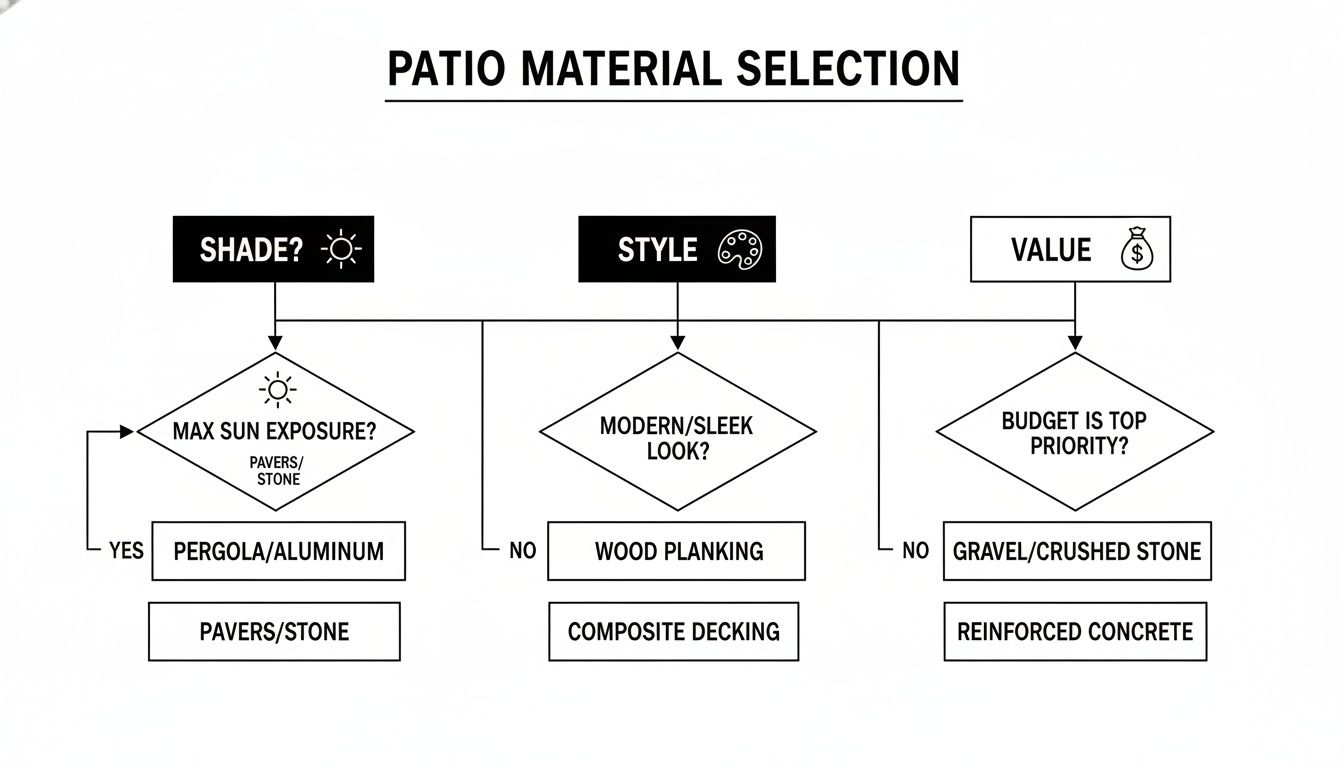
As you can see, if complete sun protection is your number one goal, the insulated solid cover is the clear path forward.
Lattice Covers for an Open and Airy Feel
Now, if you actually enjoy the sun but just want to dial back its intensity, a lattice cover is a fantastic choice. It works much like a traditional pergola, with a grid of beams that casts a beautiful pattern of partial sun and shade. This gives you a breezy, open-air feeling you just don't get with a solid roof.
A lattice cover is perfect for homeowners who want to define an outdoor space without completely closing it off. It’s excellent for growing climbing plants like wisteria or jasmine, adding a touch of natural beauty to your patio.
This style strikes a great balance between shade and openness, making it a popular pick for garden areas or poolside decks where that dappled light effect is ideal. You can browse our gallery of different patio cover styles and options to get a feel for what might look best on your home.
Modern Features to Enhance Your Space
Today’s patio covers are designed for more than just shade; they’re ready for modern comforts. Most styles come with built-in electrical raceways, making it easy to add features that turn your patio into a true living space.
- Integrated Lighting: We can install recessed LED lights to give your patio a warm, inviting glow for evening entertaining.
- Ceiling Fans: Nothing beats a gentle breeze on a still, hot day. A ceiling fan makes the space comfortable even when the air is stagnant.
Think beyond the cover itself and consider how you can get the most out of your new space. Adding simple, functional touches like exterior ceiling fans for patios and porches can completely change how you experience your backyard, turning a simple structure into a fully equipped outdoor room.
How to Budget for Your New Patio Cover in Fresno

Alright, let's get down to the numbers. When you're ready to invest in a professional patio cover installation, you need real-world figures, not just some vague guess from a national cost calculator. The best way to approach this is to think of your new patio cover as a true asset—an investment that boosts your home’s value and, more importantly, your family's quality of life.
The final price tag really comes down to a few key things. Size is the big one; pricing is almost always based on square footage. From there, the material you choose, how complex the design is, and any prep work needed on your property will all factor into the final cost.
Breaking Down the Costs
It's important to know exactly where your money is going. Here in the Central Valley, a standard, well-built aluminum patio cover typically starts in the range of $25 to $40 per square foot. If you're looking at a high-end insulated cover or a custom wood design, that number will naturally be higher. That’s because the labor, engineering, and material quality all increase as the project gets more ambitious.
But your total investment isn't just the cover itself. It also includes:
- Size: A simple 10×12 cover perfect for a small bistro set is going to cost a lot less than an expansive 20×30 structure designed for hosting big family gatherings.
- Material Choice: As we covered earlier, premium insulated panels have a higher upfront cost than standard aluminum. The trade-off? They provide far better heat reduction and tend to last longer.
- Design Complexity: An attached rectangular cover that ties right into your roofline is the most budget-friendly option. A freestanding structure, custom post placements, or adding things like electrical for fans and lights will add to the cost.
- Site Preparation: Does your concrete slab have cracks that need fixing? Do we need to pour new footings in your yard? Any site work like this will be an additional line item.
While you might see a US average for patio covers floating around $8,500, what really matters is local knowledge. Sure, some giant national companies have a lot of market share, but local specialists are the ones who build a reputation on quality and custom service. You can learn more about how the aluminum patio cover market is structured and see why working with a local pro often provides the best value.
What a Comprehensive Quote Should Always Include
A vague quote is one of the biggest red flags in this business. When you're searching for a "patio cover installation near me," you need a contractor who gives you a crystal-clear, itemized proposal. Think of the quote as the blueprint for your project—every single detail should be spelled out.
A professional quote is more than just a price; it's a promise. It should clearly outline the full scope of work, leaving no room for surprise fees or misunderstandings down the road.
Your quote should explicitly list these four things, no exceptions:
- Materials: The specific brand, style, and color of the patio cover (e.g., Alumawood, Duralum, insulated panels).
- Labor: The cost for the trained, professional installation crew to build your cover correctly.
- Permit Fees: All costs associated with pulling the required city or county permits for your project.
- Warranty: Clear details on both the material warranty from the manufacturer and the labor warranty provided by the installer.
A transparent quote like this is the sign of a true professional. It shows they're organized, upfront, and committed to making your project a success from the moment you sign on.
Sorting Out Permits and the Installation Timeline
Let's be honest—nobody gets excited about the thought of dealing with city permits and construction schedules. It can feel like a major headache waiting to happen. The good news is that a good, professional installer handles all of that for you. They’ll take the stress right off your shoulders, turning what could be a confusing ordeal into a surprisingly smooth process.
The whole idea is to give you a clear roadmap from your first design idea to the finished product. When everything is handled correctly from the start, you can just sit back and watch your new patio cover come to life.
The Project Timeline From Start to Finish
Any professional patio cover installation near me will follow a pretty straightforward path. Think of it like a recipe—you have to complete each step in the right order to get a great result.
- The Initial Chat & Design: This is where the fun begins. We’ll talk about what you’re picturing, look at different material samples, and find a style that looks great with your home without breaking the bank.
- Measuring Everything Up: Next, our team comes to your house to take precise measurements of the area. This ensures every piece is custom-made for a perfect, gap-free fit.
- Handling the Permits: Here’s where we really earn our keep. We prepare all the engineering plans and paperwork and submit them to your local city or county building department. This is a critical step that we manage from start to finish.
- Installation Day: As soon as we get the green light from the city, our in-house crew gets to work. For most standard patio covers, the actual on-site build only takes about 1 to 3 days.
Why Getting a Permit Is a Non-Negotiable
It can be tempting to try and skip the permit process to save a little time or money, but that's a huge mistake. A building permit isn't just bureaucratic red tape; it's your proof that the job was done safely and correctly.
A building permit acts as a third-party verification that your new patio cover is structurally sound, safe for your family, and built to withstand local weather conditions. It's the official record that your investment meets all legal and safety requirements.
Trying to bypass permits can open a real can of worms. For instance, if an unpermitted patio cover fails during a storm and damages your home, your homeowner's insurance could refuse to cover the repairs. It can also cause major headaches when you try to sell your house, as unpermitted work is a huge red flag for buyers and their lenders.
Any contractor worth their salt will always insist on pulling a permit. It protects you, it protects them, and it’s the only way to guarantee a high-quality, legally sound installation.
Why a Local Licensed Contractor Is Your Best Bet
When it’s time to choose an installer for your new patio cover, you’ll face one decision that outweighs all the others—even the style or material you pick. Who you hire will define the quality of the finished project, protect you from liability, and give you peace of mind for years to come.
Think about it like finding a new family doctor. You wouldn’t just go with a random name you found online. You'd look for someone with a solid reputation in your community, proper credentials, and a real office you can walk into. The exact same logic applies here. A true local contractor gets the unique challenges we face in the Central Valley, from the brutal Fresno sun to our specific soil conditions and building codes.
The In-House Crew Advantage
There’s a world of difference between a company that uses its own dedicated, in-house crews and one that shuffles through subcontractors. When a company invests in its own team, it’s investing in consistent training, quality control, and a shared standard of excellence.
Subcontractors, on the other hand, are often paid "by the piece," which naturally encourages them to work fast, not necessarily well. An in-house team’s priority is craftsmanship because their work is a direct reflection of the company's reputation. At Equity, our crews are the heart of our business, and their meticulous work is the reason we've been around for over 30 years.
The Critical Shield of Licensing and Insurance
Hiring an unlicensed or uninsured contractor is one of the single biggest gambles a homeowner can take. A valid contractor's license, like our CSLB #963161, is the very first thing you should verify. It proves the contractor has the experience and knowledge to pass state-level exams on trade practices and law.
Insurance is not a "nice-to-have"—it's an absolute necessity. It acts as a financial shield that protects you from liability if an accident happens on your property. Without it, you could be held personally responsible for medical bills or property damage.
Any reputable contractor will carry two non-negotiable types of insurance and be ready to show you proof.
- General Liability Insurance: This covers accidental damage to your property. If a worker drops a tool that cracks your concrete or a ladder falls and shatters a window, their policy pays for the repairs, not you.
- Workers' Compensation Insurance: This is absolutely vital. It covers the medical bills and lost wages for any crew member who gets hurt on your job site. Without it, you could be sued directly for those costs.
When you hire a fully licensed and insured local professional, you're not just getting a patio cover. You’re ensuring your home and finances are protected by a stable, established company that stands behind its people and its work. That’s the real difference a local partner makes.
Your Vetting Checklist for Patio Cover Installers
Before you sign on the dotted line, it's time to do some homework. Choosing the right installer is the single most important decision you'll make for your patio cover project, and asking the right questions upfront is how you protect your investment.
Think of it like you're hiring for an important role—because you are. The answers a potential contractor gives you speak volumes about their experience, professionalism, and whether they're someone you can trust on your property. A great installer will have no problem answering these questions clearly and confidently.
Essential Questions for Any Installer
Have this list handy when you meet with contractors. Pay attention not just to what they say, but how they say it. If their answers are vague or they seem hesitant, that’s a major red flag.
Can you provide your contractor's license number and proof of insurance? This should be the very first question you ask. A legitimate contractor will provide this without a second thought. You'll want to see proof of both general liability and workers' compensation coverage.
Are your installation crews employees or subcontractors? This is a huge indicator of quality control. Companies with in-house employee crews have invested in consistent training and can hold their teams to a much higher standard. It's a different world from companies that just farm out work to the cheapest available subs.
What brand of materials do you use and what is the warranty? They should be able to name a reputable brand, like Alumawood or Duralum, and clearly walk you through the manufacturer's material warranty and their own labor warranty.
The most important question you might ask is, "Does your quote include ALL permit fees and taxes?" A truly professional quote is all-inclusive. If a contractor tries to add these costs later, it’s a clear sign of dishonest pricing tactics.
Ultimately, finding the right partner for your patio cover installation near me search comes down to finding a team you trust. If you have more questions or want to get a free, detailed estimate for your project, please don't hesitate to contact our team at Equity Building Materials. We’re here to help you get it right.
Common Questions About Patio Cover Installation
When you start thinking about a new patio cover, questions naturally come up. After helping hundreds of homeowners in Fresno and Clovis, we’ve heard just about all of them! Getting clear, straightforward answers is the first step toward a successful project, so let's tackle the most common ones we hear.
How Long Does Installation Take?
This is usually the first thing everyone wants to know. The actual on-site work is faster than most people expect. For a standard attached patio cover, our crews are typically in and out in just 1 to 3 days.
The bigger variable in the overall timeline is the permitting process. From your first consultation to the final sign-off, the whole project can take a few weeks, depending on how quickly the city or county approves the plans.
Is a Patio Cover a Good Investment?
It’s one of the smartest investments you can make for your home, especially here in the Central Valley. A well-built patio cover effectively expands your home's living space. It transforms a sun-baked, unusable patch of concrete into a cool, comfortable spot for family dinners, morning coffee, or just relaxing outdoors.
Think of it this way: a patio cover adds functional square footage to your home. That not only gives you immediate lifestyle benefits but also boosts your property's appeal and long-term value when it's time to sell.
Do I Need a Permit for a Patio Cover?
Yes, a building permit is almost always required for a new patio cover in Fresno, Clovis, and the surrounding areas. This isn’t just bureaucratic red tape; it’s a crucial safety measure.
A permit ensures your patio cover is engineered to withstand wind and other loads, meets all local building codes, and is officially documented. This protects you and prevents any headaches down the road if you decide to sell your home. Any reputable contractor will manage this entire process for you from start to finish.
What Is the Difference Between a Patio Cover and a Pergola?
This one is simple, and it all comes down to the roof.
- A patio cover has a solid, non-transparent roof. This gives you complete protection from the sun's heat and rain, creating a true all-weather outdoor room.
- A pergola (or lattice cover) features a slatted, open-grid roof design. It provides partial, filtered shade, which breaks up the intense sun while still allowing for an open, airy feeling.
Choosing between them really depends on your goal. Are you looking for a full outdoor shelter or just a way to diffuse the harshest sun?
At Equity Building Materials, Inc., we believe a great project starts with clear information. For over 30 years, our in-house, insured crews have helped Central Valley homeowners make smart, lasting improvements to their homes. If you're ready to transform your backyard, get in touch with us for a free, no-pressure estimate. Find out more about our process and materials.